Local Weather Alerts - Widget
- 4.8
- Rating
- 10.00M
- Installs
- Free
- Price
 Analysis by App-foxy
Weather apps are easy to overlook until a forecast gets something important wrong. I tested Local Weather Alerts - Widget as a day-to-day weather tool, and what stood out first was its straightforward approach: it is built around local conditions, forecast changes, and a quick view that does not ask me to dig through a complicated dashboard. That makes it appealing when I want to know whether I should take an umbrella, change my commute, or wait before heading outside.
This is a free weather app from Vitality App Studios, available for everyone and designed for devices running Android 6.0 or later. Its current version is 1.7.2, and it has built a sizable audience, with more than ten million installs and an average rating of 4.8 from roughly 333 thousand ratings. Those figures do not replace personal testing, but they do suggest that the app has found a practical balance for many people who want local weather information without paying at the starting point.
How Local Weather Alerts - Widget fits into everyday weather checking
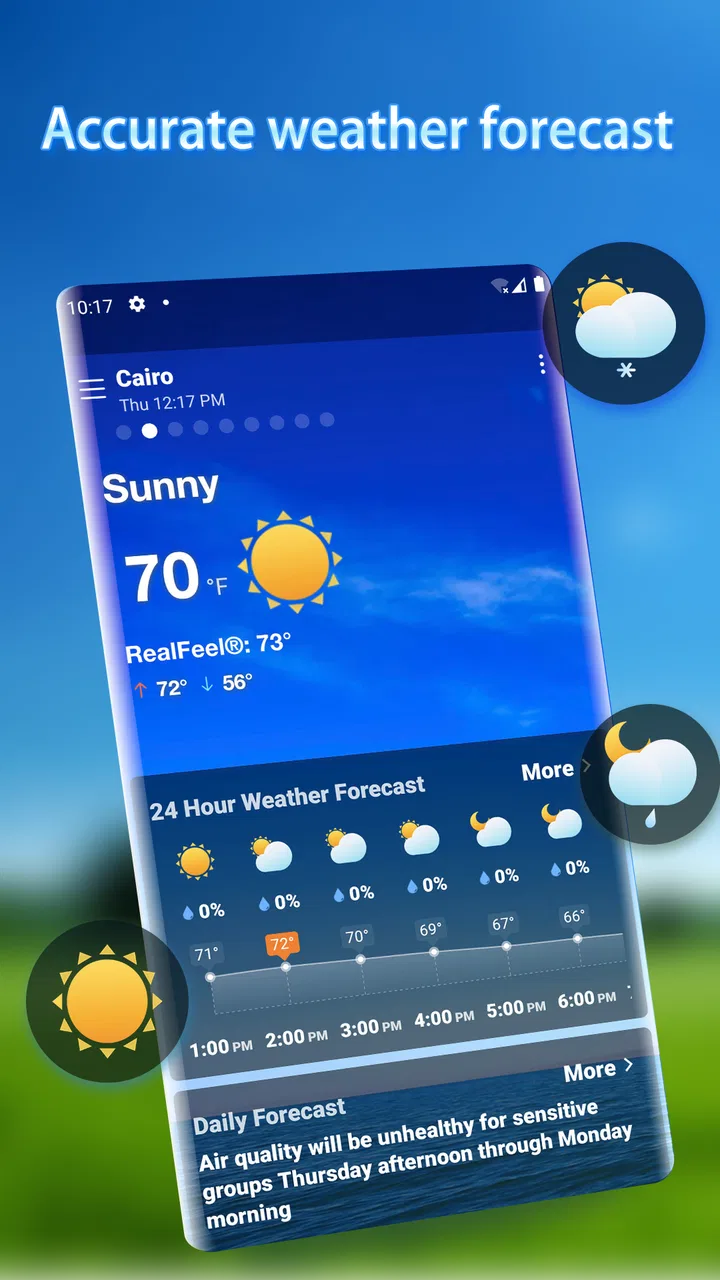
The app’s main strength is not that it tries to turn weather into an elaborate experience. I found it more useful as a quick reference that I could consult several times a day. The store’s short description calls it “Local Weather,” while its broader summary focuses on accurate forecasts and making daily changes easy to understand. In practice, that positioning matters: this is best approached as a glanceable weather companion rather than a specialist forecasting workstation.
You May Also Like

 Blood Strike: 2.5 Anniversary
Blood Strike’s Loadouts Turn Every Drop Into a Tactical Gamble
A close look at Blood Strike’s custom loadouts: how fast access to signature weapons reshapes its battle royale rhythm, rewards preparation, and narrows the gap between fights.

 Pandora - Music & Podcasts
Pandora’s Music Is Easy to Start, but Harder to Recover
Pandora’s strength is its low-effort path from a seed to a station. Its weak spot is how much confidence it asks you to place in connection, setup, and quiet recovery.

 8 Ball Pool
 Is Built on Rivalries, Rematches, and Routine
A close look at the rivalries, rematches, shared routines, and unanswered safety questions that turn a quick pool match into a persistent mobile community.

 Samsung Music
’s Quiet Strength Is Playing What You Already Own
Its reach comes less from spectacle than from dependable access to a personal library. That simplicity is both the app’s strongest retention engine and its ceiling.

 AccuWeather: Weather Radar
AccuWeather Review: A Quick, Clear Forecast for Everyday Decisions
For everyday plans, the best forecast is the one you can understand quickly. AccuWeather makes rain timing, radar, and local conditions easy to act on, with a few trade-offs.

 Hill Climb Racing
Why Hill Climb Racing Still Turns Crashes Into One More Run
A tiny car, a bumpy hill and one more upgrade: Hill Climb Racing keeps resurfacing because its simple chaos makes every near-miss feel personal.
More From Our News Desk



For example, imagine leaving home for work on a morning when the sky looks clear. Instead of relying on appearance alone, I can check the local forecast, see how conditions are expected to change, and decide whether a light jacket or rain protection makes sense. Later, before lunch or the journey home, another quick check can reveal whether the situation has shifted. That simple routine is where the app feels most natural.
The widget-oriented design is particularly relevant for people who do not want to open a full app every time they need an update. A home-screen weather view can turn a forecast check into a glance rather than a task. That is a small convenience, but it changes how often I use a weather service. When information is visible at the right moment, I am less likely to make a decision based on an old forecast or a quick look out the window.
I also appreciate the focus on changes across the day. A single temperature number is rarely enough to plan properly. Morning, afternoon, and evening can feel very different, especially when rain or wind enters the picture. The app’s emphasis on making daily changes easier to grasp gives it a practical edge over weather tools that present a dense list of readings without helping me interpret the day as a whole.
A useful setup for quick decisions
When I use a weather app regularly, I want the first screen to answer a few basic questions quickly: what is happening locally, what is likely to happen next, and should I alter my plans? Local Weather Alerts - Widget is most convincing when used for those decisions. It does not need to become the center of my morning routine; it simply needs to remove uncertainty at the moment I check it.
That makes it suitable for several ordinary situations. I might check it before walking a dog, deciding whether to cycle, planning outdoor errands, or choosing clothing for a school run. Someone who works outdoors could use it as one part of a broader planning process, while a traveler could consult it before leaving a hotel. For serious safety decisions, I would still treat any consumer weather app as a useful reference rather than the only source of information.
One practical tip is to compare the forecast with the actual conditions during the first few days of use. Weather information is local, but local conditions can still vary around a town, particularly near coastlines, hills, or dense urban areas. If the app’s forecast matches what I experience, I gain confidence in using it for routine planning. If my location behaves differently, I know to allow more caution instead of assuming every forecast detail will fit my exact street.
Free access and what paid value means here
The app is free to download and use, which is important when comparing it with subscription-based weather services. I can try its core experience without committing money first. That lowers the risk for casual users who only need a dependable way to check conditions and do not want another recurring bill.
There are in-app purchases priced from $2.99 to $4.99 per item. That gives the app a paid layer, but the listed price range alone does not tell me that every purchase is necessary for ordinary weather checking. My value judgment is therefore simple: the free access is the main reason to try it, while a purchase should be considered only if the specific paid option solves a problem I actually have.
I would not pay automatically just because a weather app offers extra tools. Before buying, I would use the free version long enough to understand whether its local forecast and widget fit my routine. If I only need a quick daily glance, the free experience may already provide enough value. If I want more from the paid side, I would first identify the exact convenience or enhancement being offered and decide whether it changes my daily use rather than merely adding another screen.
This distinction is important because weather information is widely available. Phone operating systems often include basic weather access, and many general search tools can show current conditions. A paid purchase here needs to earn its place through a smoother workflow, clearer presentation, or a feature I genuinely use. Without that personal need, keeping the free option is the more sensible choice.
Where the app feels better than usual alternatives
The most obvious alternative is the weather panel already built into a phone. That option wins on convenience because it requires no extra installation and may already appear in a familiar place. However, built-in weather views can be limited or visually compressed. Local Weather Alerts - Widget has a stronger case when I want weather to be a more deliberate part of my home screen rather than a secondary system feature.
Another alternative is a large forecasting service aimed at enthusiasts. Those apps may offer more layers, maps, radar views, alerts, and technical detail. They can be excellent for people who track storms or plan activities around changing conditions, but they can also make a simple question feel unnecessarily complicated. I prefer this app’s more approachable role when my question is simply whether the day is becoming wetter, colder, or less suitable for outdoor plans.
There is also a difference between a forecast app and a news-style weather source. A broadcaster’s weather page may provide helpful regional context, but it often takes more steps to open and scan. A widget reduces that friction. The trade-off is that a widget cannot replace the depth of a full weather report. I see the app as a fast first check, with more detailed sources reserved for unusual or high-consequence conditions.
Small habits that make it more useful
The first habit I recommend is checking the whole day rather than reacting only to the current temperature. A pleasant morning can create false confidence if rain is expected later. Looking at the progression helps me plan clothing and travel more intelligently than reading one current-condition number.
The second is to use the widget as a planning trigger, not as background decoration. If I notice a major change before leaving, I can open the app for a closer look and adjust my timing. This is more useful than checking it once at breakfast and assuming the forecast will remain fixed.
The third is to separate convenience from certainty. A clear display can make information easier to understand, but it does not make weather perfectly predictable. I would use the app confidently for routine choices, while giving myself extra time and checking additional official guidance for severe weather, long outdoor events, or travel where a mistake would be costly.
A fourth useful approach is to judge the app by decisions, not by how much information it displays. If it helps me leave with the right clothing, avoid an unnecessary wet walk, or choose a better time for an errand, it is doing its job. More charts would not automatically make it better for me. In fact, additional detail can slow down the quick checks that make a widget valuable.
Limitations I noticed in the overall proposition
The app’s simplicity can become a limitation for advanced users. People who want deep meteorological detail, extensive map layers, or a highly specialized view may find a dedicated forecasting service more appropriate. The focus on accessible daily changes is a strength for general use, but it does not automatically satisfy every technical weather hobbyist.
The widget format also depends on how much attention I want to give my home screen. Some people enjoy having weather visible all the time; others prefer a clean screen and do not want another information panel competing for space. If I rarely check conditions or already rely on a built-in weather shortcut, installing another app may not noticeably improve my routine.
There is also a natural trade-off between a quick overview and detailed context. A glanceable forecast helps me decide quickly, but a compact presentation may not answer every follow-up question about a developing weather system. When the weather is unusual, I would want to investigate further rather than treating the app’s first view as a complete briefing.
The paid layer deserves the same caution. Since purchases range from $2.99 to $4.99 per item, the cost is not automatically high, but value depends on what each option adds to my personal workflow. I would not describe paid access as essential for everyone. The free starting point is the clearest value proposition, and purchases make sense only when they provide a benefit I can identify and expect to use repeatedly.
Who will get the most value from it?
I think the best audience is people who want a local forecast that is easy to absorb without becoming weather experts. Commuters, parents, walkers, cyclists, students, and anyone who plans several small outdoor activities during the day can benefit from a view that highlights changing conditions rather than forcing them to interpret a dense data set.
It is also a good fit for users who like home-screen widgets and want weather available before opening a full application. The convenience becomes especially clear during busy mornings. I can glance at the forecast while preparing to leave, then make a quick decision about clothing or transport without interrupting everything else I am doing.
Casual users should also appreciate the free entry point. Someone who has never settled on a weather app can try this one without paying upfront, learn whether the presentation suits them, and keep using it if it becomes part of their routine. Its Everyone content rating makes it appropriate for a broad household audience, including people who want a simple weather reference rather than a technical tool.
I would be more hesitant to recommend it as the sole choice for users who need highly specialized forecasting, detailed storm analysis, or professional-grade planning. They may be better served by an alternative built around those needs. I would also suggest skipping it if the phone’s existing weather feature already gives you the exact local view you want and you do not care about adding a separate widget.
My buy-or-skip verdict
After using it as a practical weather companion, I see Local Weather Alerts - Widget as a sensible free option for people who value quick local checks and an easy-to-read view of how the day may change. Its strongest quality is not an intimidating collection of tools; it is the reduction of friction between wondering about the weather and making a decision.
The developer, Vitality App Studios, has positioned the app for broad everyday use, and the large install base and strong average rating show that this approach resonates with many users. I would still judge it by my own routine rather than popularity. If I need a simple forecast glance several times a day, the free access gives me a low-risk reason to try it.
My advice is to start without buying anything. Set up the weather view in the way that best matches your habits, check the daily progression instead of only the current condition, and see whether it genuinely improves decisions about commuting, errands, or outdoor plans. Only consider an in-app purchase if a paid option addresses a clear annoyance or adds a convenience you will use often.
My final recommendation: try it if you want an approachable local weather app with widget convenience, especially when free access is your priority. Skip it if you already have a satisfactory built-in forecast or need advanced meteorological tools. For ordinary planning, it offers useful value without demanding a subscription, while its limitations are clear enough that experienced weather users will know when to reach for something more specialized.
FAQs for Local Weather Alerts - Widget
01What features does Local Weather Alerts - Widget offer?
Local Weather Alerts - Widget provides real-time weather updates, customizable alerts, and a sleek widget for your home screen. Users can personalize notifications for severe weather conditions, ensuring they stay informed about local weather changes. The app also offers detailed forecasts, radar maps, and temperature trends to help users plan their activities.
02Is Local Weather Alerts - Widget free to use?
The app is available for free with basic features. However, for advanced options like ad-free experience, extended forecasts, and premium alert settings, users may need to subscribe to a paid plan. This subscription can enhance user experience by providing more detailed weather insights and customization options.
03How accurate are the weather alerts provided by the app?
Local Weather Alerts - Widget uses data from reliable meteorological sources to ensure accuracy in its forecasts and alerts. The app is designed to update frequently to provide the most current weather information. While no app can guarantee 100% accuracy, users generally find the alerts timely and helpful for planning.
04Can I customize the widget's appearance on my home screen?
Yes, the app allows users to customize the widget's appearance, including size, color, and layout, to match their home screen preferences. Users can also choose which weather data to display, such as current temperature, forecast, or severe weather alerts, making it convenient and personalized.
05Does the app require constant internet access to function?
Local Weather Alerts - Widget requires an internet connection to update weather data and send alerts. However, once the data is downloaded, some information may be accessible offline. For the most accurate and timely information, it's recommended to have a stable internet connection.
Pros
- Accurate real-time weather updates.
- Customizable alert settings.
- Intuitive and user-friendly interface.
- Low battery consumption.
- Supports multiple locations.
Cons
- Frequent ads can be distracting.
- Limited free features available.
- Occasional server downtime.
- Requires constant internet connection.
- Widget design lacks customization.

Local Weather Alerts - Widget
Gallery